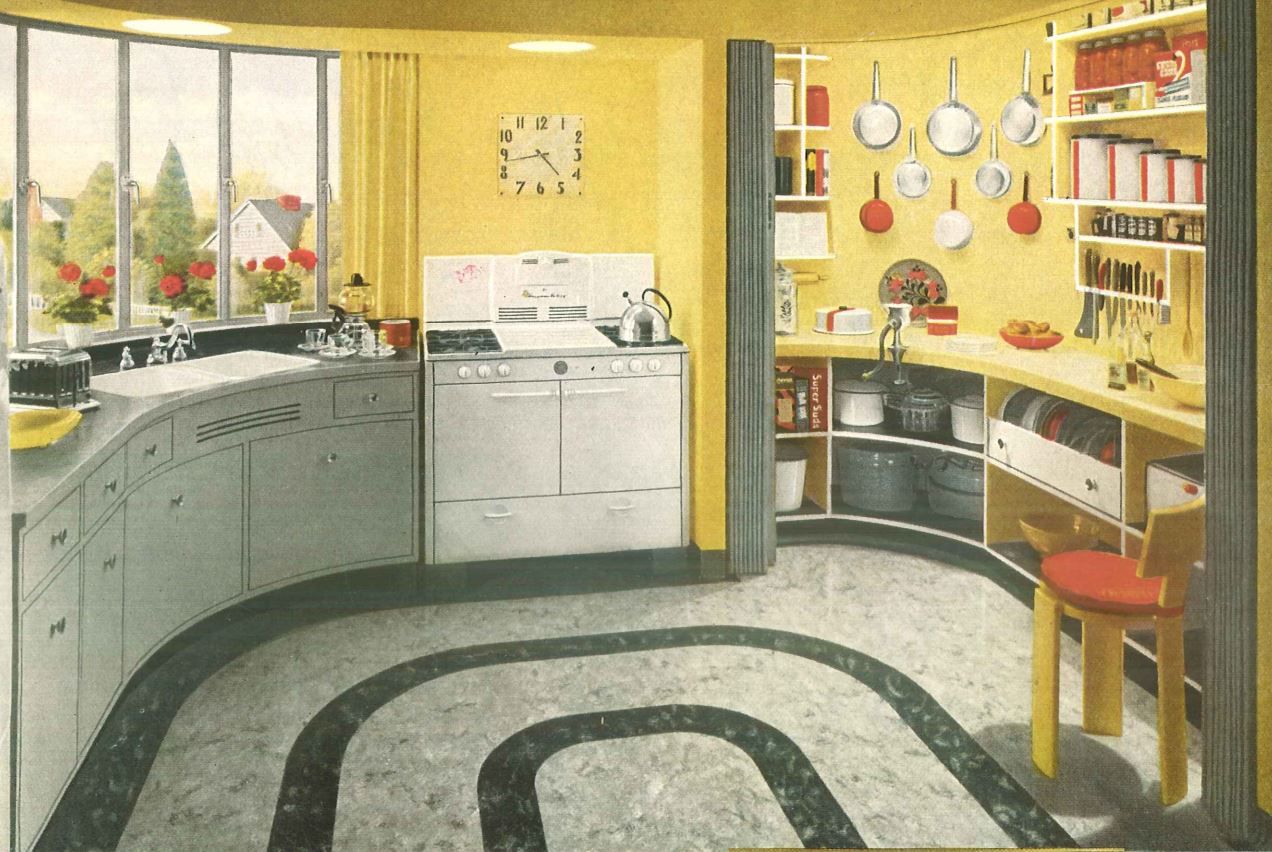
Home design in the 1940s, especially in the kitchen, represented a rapid shift. Older styles and materials were quickly replaced. New ideas took hold, and the kitchen was transformed.
Because of World War II restrictions, it would not be until the late 1940s and into the 1950s that many of these new materials found their way into home design. Chiefly, the rationing of metal adversely affected the production of steel kitchen cabinets.
Home design styles in the 1940s straddled the 20th century. On the one hand, kitchens were still fairly small. Linoleum was still widely used as a floor covering. Colors often hovered in the range of pastels. Iconographic shapes like scallops, sweeps, and curves were common. Unfinished pine was a favored inexpensive wood often used for kitchen cabinets. These were touches that hearkened back to an earlier, more innocent age before the war.
On the other hand, the sleek styles that would characterize the Jet Age period of the late 1950s and 1960s, while still on the horizon, would begin to occasionally show up. Large tempered plate glass found its way into higher-end homes. Some of these curves and scallops began to straighten out. Lines and planes were common.
1 of 8
1940s Home Design: a Transitional Period
:max_bytes(150000):strip_icc():format(webp)/1940sKitchenDesignwithBigWindows-ee29ff6d26a44520b122cfece8a92e9d.JPG)
In this 1946 kitchen design, linoleum is the star since it is from a publication called Portfolio of Room Interiors, produced by Armstrong World Industries Inc. Three types of linoleum are combined to form this floor.
2 of 8
Curved Floorplan for 1940s Kitchen
:max_bytes(150000):strip_icc():format(webp)/1940sYellowKitchenDesign-81d2e04da9754ae1b8435242c99522d3.JPG)
This uniquely designed kitchen works off of an oval shape to facilitate workflow. Sink, stove, and refrigerator are all within easy reach. Base cabinet open shelves help the cook locate and retrieve pans. Shades on the right side pull together to close off and hide part of the kitchen.
3 of 8
Blue 1940s Kitchen Full of Linoleum
:max_bytes(150000):strip_icc():format(webp)/1940s-kitchen-in-blue-56a49da45f9b58b7d0d7dac2.JPG)
In this kitchen, linoleum is used not just for the flooring, but for the sink surround and countertops. Rarely is linoleum found on kitchen countertops, even in the 1940s. Yet the designer noted that linoleum here would be “clatterproof, easy to clean, and resistant to stain.” Even the scalloped swags near the ceiling were cut from linoleum.