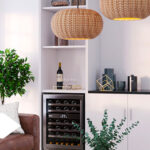
Balance is an interior design fundamental that addresses the distribution of visual weight within a space to achieve a feeling of equilibrium. Balance is something that often guides us inadvertently when we’re arranging furniture, displaying art, and creating decorative vignettes. That said, when we are putting conscious thought into achieving balance, the default tends to be literal balance: symmetry. But symmetrical balance is just one of three types of balance.
In this guide, we will be talking about symmetrical balance’s edgy counterpart: asymmetrical balance. Asymmetrical balance involves the use elements with cohesive visual weights to create a visually pleasing, well-integrated space, without mirroring or exact duplication. Asymmetrical interiors tend to feel more dynamic and imaginative than symmetrical ones, but they can also be more difficult to execute because asymmetry isn’t as intuitive as symmetry. For that reason, mastering asymmetrical balance in your own interior space can be extremely rewarding.
Using asymmetry over symmetry in interior design.
In the context of interior design, asymmetry is inherently more interesting than symmetry because asymmetry is unexpected. Because of that surprise factor, our brains have to take more time to process and appreciate asymmetrical design—and believe it or not, the human brain generally likes to be challenged in that way…