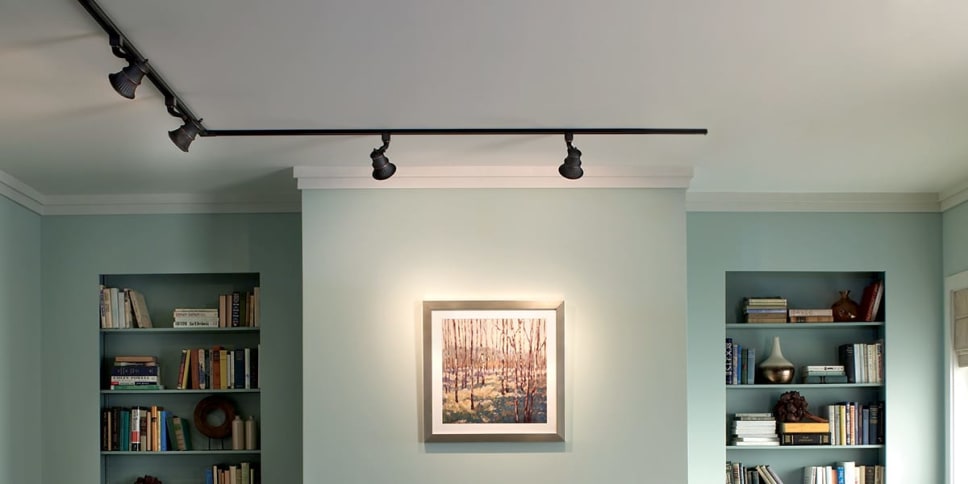
In the vast world of lighting, there are a lot of shiny, sparkling pieces that exist only to light up a room. Some are intended to offer soft light, others bright light, and some are just there to add a little color. It’s easy to get lost in the crowd, sorting through every type and design to find the one that suits your home best. The lighting should be bright enough to do the job, but also something that works with the design of the room, and those defining characteristics are not always clear when shopping online.
With track lighting in particular, not only are there a lot of options, there’s a fair amount of confusing information. An online search returns conflicting definitions of terms because track-based lighting systems are so unique that they even use common parts differently from the rest. It can be frustrating to find the answers to the simple questions. It doesn’t need to be. Before you buy a track lighting system, look at the basics that follow and decide for yourself if track lighting is the answer to your home lighting system setup.
What Is Track Lighting?
Track lighting is – as the name implies – any lighting feature that uses a ceiling mounted support track or a rail to provide the electricity to individual light fixtures. With any other lamp, (or luminary,) a light bulb twisted into a lamp socket creates the electric connection with the lamp in order to light up the bulb inside. Track lighting works much the same way, except the whole light fixture itself connects to the track to draw energy, rather than just the bulb.
This allows flexibility in placement as the lights can be attached to the track anywhere they are needed, rather than at a particular fixture like a light bulb socket requires. Standard incandescent, low-voltage Halogen/Krypton, CFL, and energy-efficient LED track systems are all available, just like any other lighting solution. The luminary can be angled to cast light in all directions along the track, or can be moved to another spot along the track, and there’s no new wiring required or no new electrical plugs to be found. The track or rail is electrified at one end and can be extended or curved to reach out from the source.
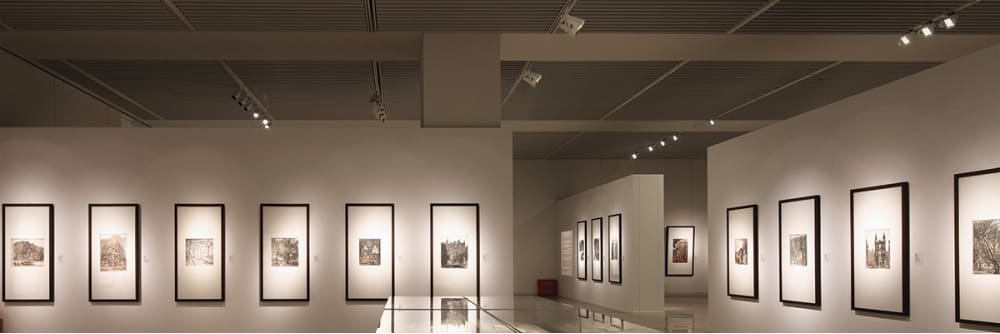
Designed to be fully customizable, the different track systems sit close to the ceiling and out of the line of sight, while providing more directional light than a ceiling lamp can offer. They provide bright, clear illumination or soft dimmable lighting to accent the design of the room itself. The individual lighting fixtures can be fit with a variety of shapes and sizes to help them blend in, whether the look is traditional or contemporary.
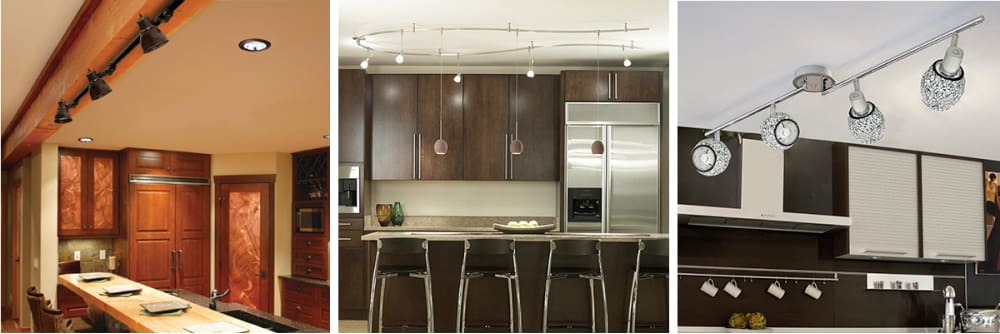
While they are all considered a form of track lighting, monorail lighting and cable lighting are not the same as standard track lighting. They are each different lighting systems while offering similar characteristics, but they are in no way interchangeable. Track lighting, cable lighting, or rail lighting, are all very distinctive in their design and can fit easily into either your home or your business decor. They all allow you to design your own layout, creating a maze on the ceiling of straight lines, boxes, or curving and playful rails. They are useful in any space, from rooms with a high ceiling that require a brighter spread over a large area, to cramped hallways and closets, to kitchens. While track lighting blends in well to any modern design, cable lighting provides a very industrial, contemporary look, anchoring to walls as well as the ceiling to enable the light to reach otherwise difficult lighting spaces. The rails can be installed with gentle curves or full circular shapes to add interest, or they can follow the walls, even taking 90-degree turns to adjust to corners.
Types of Track Lighting
The defining characteristic of track lighting is that the light mounts on a support track in order to power the fixture. Over the years, the look of the track has evolved into different designs to allow you to configure the luminary to suit your space. These different styles all fall under the general umbrella of track lighting, however, they are all very different forms of lighting systems.
Standard Linear Track Lighting
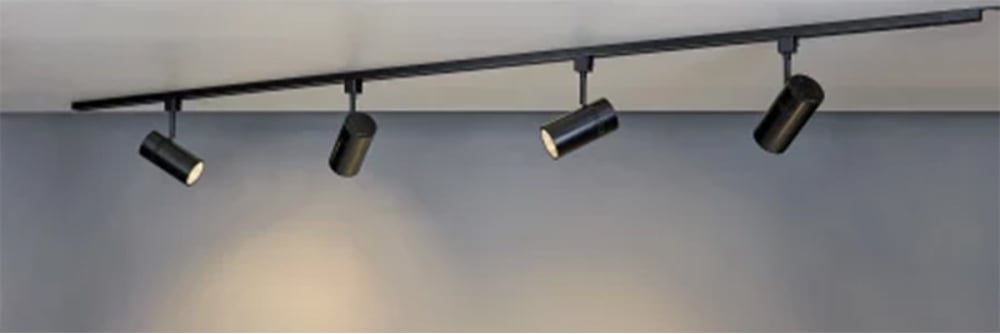
Standard linear track lighting is the “traditional” track lighting, easily installed with simple screws and connected to existing electrical circuits, usually in the ceiling. An enclosed and hollow, square-edged bar is mounted to the ceiling, and the light fixture is inserted between the tracks and twisted to catch the inside ledge of the bar to secure the luminary. Inside, exposed electrical conduit run the length of the track, secured in grooves, and the metal in the base of the luminary touches the connections, powering the individual light by the circuit at the end of the track.
The tracks usually come in straight bars, ranging from 2-foot to 8-foot lengths. They can be run in straight lines parallel to the walls, or they can be connected in specific layouts, like a corner angle, or multiple pieces can be connected to create an X-shape. The tracks are powered by either line voltage or low voltage wiring running from the circuit to the end of the bar, in 2- or 3-wire configurations. Connectors are used to attach separate track pieces together and allow the live current to continue from track to track.
Track heads are light fixtures that connect to the track and are usually 12 or 24 volts, so they consume less energy, which means a less expensive energy bill. These include a transformer, built into the track head base, to step down the current from your home’s 120 volt circuit. Since each individual light has the transformer already included, linear track lighting doesn’t require a separate transformer to power the entire system.
There are three standard types of tracks used in North America: H type, J type, and L type. The standards between the three types were developed by three different manufacturing companies, Halo, Juno, and Lightolier, which they are named for. There are additional types that can vary by manufacturer, such as the two-circuit J2 system, which is used to control two sets of lighting on a single track. The tracks are similar in features and options when it comes to performance, but they are not interchangeable. The individual light bases insert into the track and twist to lock in place, powering the lights through the connection to the conduit in the track, so the light and track pieces have to fit together smoothly…